
Explained: Restaurants, Workplace Opening and Operation License in Turkey

Turkey has not only one of the richest cuisines in the world, but also it is one of the most popular destinations for tourists from all around the world. Between the years 1993 and 2021, tourist arrivals in Turkey averaged (annually) as 1,782,343.59, reaching an all-time high of 6,617,380 persons in July of 2019 and a record low of 24,328 persons in April of 2020. Despite Covid19’s adverse impacts on total numbers of the last two years, Turkey is expected to easily recover and continue to attract foreign and national tourists in the coming years. Combining with the drastic decrease in the Turkish Lira’s value, foreign investors will relish the opportunity to catch the forthcoming bounce-back wave in the tourism sector with the opening of new restaurants, cafes, and entertainment establishments. Therefore, we decided to provide some insights on how to open a restaurant in according to Turkish law.
In Turkey, Workplace Opening and Operation Licenses are arranged through regulation numbered 2005/9207. Sanitary and non-sanitary establishments are handled separately in the above regulation. Restaurants are included in the category of sanitary establishments, and this paper solely reviews legal conditions for restaurants without liquors. Restaurants with liquors have other necessities, all of which are required to be met by the investors.
General and specific requirements sought in restaurants with business workplace opening and operation licenses are specified in the respective regulation. These requirements are listed in the pertinent regulation as follows:
General
Article 5:
a) Measures foreseen in the legislation regarding occupational health and safety have been taken,
b) The unanimous decision of the flat owners to open a restaurant… in the independent sections of the real estates that are within the scope of Turkish Condominium Law no.634
g) For workplaces on the side of the highway, road traffic safety has been provided and a passageway permit has been obtained,
h) … all kinds of workplaces with more than thirty employees, business centers, bazaars, and similar workplaces that do not have a direct connection to the street and the street except for the main entrance doors, where more than one workplace is located, obtaining a fire department report showing that the necessary precautions are taken against fire, in other workplaces necessary measures have been taken against fire,
k) Facilitating measures required for disabled persons to enter and exit the workplace have been taken,
l) Complying with the provisions of the legislation on foreigners regarding the opening and employment of businesses by foreign nationals.
Proper execution of the above-listed necessities is inspected by competent authorities of Turkey.
Special Conditions
The list below shows the minimum requirements that must be met in workplaces:
1- The workplace shall be designed following its purpose, and it needs to be clean and bright.
2- The workplace shall have a sufficient ventilation system; heating and ventilation shall be done with a suitable stove, heater, or air conditioning system.
3- In workplaces that are opened with a single license and have more than one field of activity, the conditions stipulated in the relevant departments shall be sought for each activity branch.
4- Independent workplaces with more than ten employees shall have a place for resting, a changing cabin, and a separate toilet for men and women. However, if there are enough washbasins and toilets reserved for common use in places such as business centers, malls, passages, stations, terminals where there is more than one workplace, a separate toilet and sink requirement is not a must.
5- Necessary measures shall be taken for both collection and storage of garbage and similar wastes produced in the pertinent workplace and a proper connection shall be found to ensure proper discharge of wastewater.
6- In workplaces where food and beverages are sold, stored, and served; floors, walls, and surfaces in contact with food shall be made from easily cleaned, washed, and disinfected materials such as ceramic, marble, and stainless steel; ceilings shall prevent misting, mold and dirt accumulation; doors shall be easy to clean and disinfectable when necessary. A chimney system shall be installed to evacuate the steam, odor, smoke, and similar contaminants in the food preparation and cooking section. Cups and plates glass or porcelain; spoon, fork and knife shall be made of stainless steel.
7- In accordance with up-to-date version of t respective regulation, fire-fighting measures are required to be provided to make sure the safety of employees and customers in workplaces that do not require a fire department report.
8- In public resting and entertainment places and other workplaces where people frequently in and out, entrances and exits shall be conducted from separate doors, and there will be an emergency evacuation exit against fire all of which must be indicated with a lighted sign.
9- Public, entertainment and accommodation places, restaurants and patisseries shall have water connected to the city network, and the smoking and non-smoking sections shall be separated by walls or glass.
10- The floors and walls of toilets in public resting and entertainment places, accommodation places, wedding halls, restaurants and similar workplaces shall be covered with easily cleanable, washable and disinfectable materials such as marble, ceramic, and mosaic. Toilet and kitchen will not be designed next to each other.
Additional Terms
a) First class restaurants
1- There will be at least two cooks with a mastership certificate issued by the respective institution(s).
2- The kitchen will consist of three sections preparation, cooking and dishwashing areas. Hot and cold water plumbing for washing will be always present.
3- There must be a large entrance hall at the entrance.
4- All the walls, including the entrance and the hall, will be painted, or covered with oil paint or similar materials approved by the competent authorities.
5- Heating, cooling and ventilation will be operated through necessary equipment suitable for first-class restaurants.
6- The floor of the entrance and the hall will be covered with an easy-to-clean and disinfectable material such as wooden parquet, ceramic or marble.
7- There will be enough wheeled service tables to serve drinks and food.
8- There will be good quality clothes and napkins on the tables.
9- The plates are of uniform and good grade porcelain or glass; Forks, spoons and knives will be made of good grade stainless steel. There will be crystal, ceramic or porcelain trays on the tables.
10- There will be separate toilets for men and women with flowing mirrors, sink, liquid soap, dryer or napkin. Such toilets are required to be in full compliance with the needs of persons with disabilities. In addition to the above, there must be a children's section in which there is a small room for children and a child’s toilet.
11- There will be mosquito/fly nets on the doors and window openings to the outside of the kitchen.
12- Waiters and employees will wear special uniforms determined by the restaurant.
13- The restaurant will have a parking lot enough to cover its total customer capacity.
14- The kitchen will be designed in a way where customers can directly see it.
15- There will be a cloakroom with a counter sufficient for the total customer capacity of the restaurant.
b) Second class restaurants
1- At least one cook with a mastership certificate issued by the respective institution(s) will be present.
2- The kitchen will consist of three sections preparation, cooking and dishwashing areas. Hot and cold water plumbing for washing will be always present.
3- The floor of the kitchen, entrance and hall will be covered with an easily cleanable, washable and disinfectable hard material such as ceramic or marble.
4- There will be sufficient installations for heating, cooling and ventilation.
5- There have to be clothes and napkins on the tables.
6- The kitchen will be in a separate place from the hall, and there will be mosquito/fly nets on the doors and windows openings to the outside of the kitchen.
7- There will be enough toilets with mirrors, sinks and liquid soap for men and women.
c) Third class restaurants
1- There will be at least one cook with a mastership certificate.
2- The kitchen will consist of three sections preparation, cooking and dishwashing area.
3- The floor will be covered with an easy-to-clean, washable and disinfectable hard material such as ceramic, marble or mosaic.
4- Ventilation will be provided with at least an aspirator.
5- There will be enough toilets with mirrors, sinks and liquid soap for men and women.
d) Stand to eat places and places that sell food in the package, and cafeterias
1- It will consist of at least two parts: the place for cooking and cleaning the pots.
2- Ventilation will be provided with at least an aspirator.
Opening a Workplace
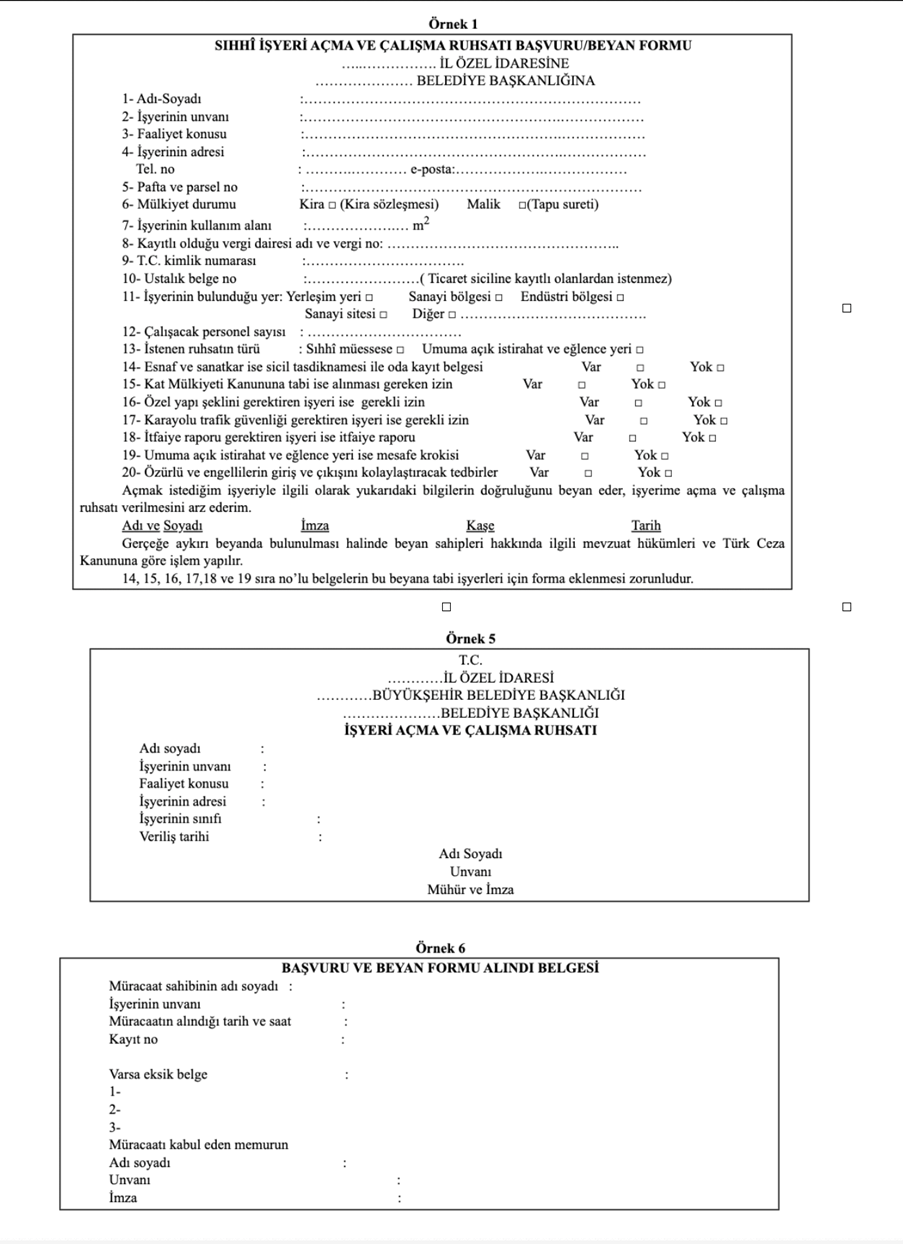
A license is required for opening and operating a workplace. Real or legal persons who want to open a workplace regulated under “sanitary places” must apply to the authorized governmental bodies by filling out the forms given in examples 1 and 2 below after the workplace(s) are arranged in accordance with the specified conditions. The authorized administration refers to, within the scope of Article 4-a of the regulation numbered 2005/9207, “For areas outside the municipal boundaries and adjacent areas and the special provincial administration in the matters authorized exclusively, provincial special administration; the metropolitan municipality within the boundaries of the metropolitan municipality and adjacent areas for which the metropolitan municipality is authorized, and the metropolitan district or first-degree municipality for matters other than these; the municipality within the boundaries of the municipality and adjacent areas, and the legal entity of the organized industrial zone within the boundaries of the organized industrial zone”. Real persons are individuals born with full and right birth, and legal persons are legal bodies formed by real persons who come together for commercial or social purposes and have an independent personality/responsibility before the law.
Within the scope of Article 12, “If it is determined that the application complies with the criteria stipulated in the Regulation, a workplace opening and working license is issued and given to the relevant person on the same day without the need for any further action.” The license is issued as shown in Example 5.
“In the application, no documents other than the information and documents specified in this Regulation can be requested during the application for opening a business and working license, and the license procedures are finalized according to the declaration in the application form.”
In the license application, the receipt document shown in Example 6 is required to be submitted. “In addition, the deficiencies detected in the preliminary examination to be made by the official who accepted the application during the submission of the application and declaration form and the attached document are shown in the receipt document given to the applicant. Periods for licensing specified in this Regulation start with the submission of the missing documents to the competent authority.”
However, the license issued based on the declaration of the applicant does not grant an acquired right. In this case, the license issued under the current legislation expires if it fails to meet the respective requirements under legislation that comes into force later.
As per Article 11 of the regulation numbered 2005/9207, licenses are conditioned to be hung on the wall in a way that everyone can see, effortlessly. The licensed workplace is checked by the competent authorities within one month at the latest from the issue date of the license. If there is no control within this period, the license becomes final and certain. Article 13 of the regulation numbered 2005/9207 states that during the audit “In case of detection of non-compliant elements and deficiencies, the workplace is given fifteen days, for once, to correct these deficiencies and errors.” If such deficiencies and irregularities are not remedied within fifteen days, the pertinent workplace is not only closed by the competent authorities but also the applicant’s license is revoked. Also, again Article 13 clearly underlines the importance of the correct statements submitted by the applicants by stating the following, “if there are false and/or misleading statements of the concerned parties, legal action is taken against them.”
Finally, details of the implementation of specifications and its procedures are also provided under additional articles of this regulation.
New Developments
In the year 2021, a new paragraph was added to Article 32 of the regulation numbered 2005/9207 and entered into force on 17 April 2021. According to the newly added part of Article 32, unconfirmed licenses are issued for workplaces that offer hookah tobacco. The conformity certificate for offering hookah tobacco products, which is obligatory for the sale of offering hookah tobacco should be submitted to the authorized administration within one month after the issue of unconfirmed license. Otherwise, the unconfirmed license is cancelled, and the workplace is shut down by the competent authorities.
Moreover, the Regulation on Amendment of the Regulation on Workplace Opening and Operation License was published in the Official Gazette No. 31553 on 30 July 2021. The amendment extends the compliance period for certain types of workplaces. The deadline for compliance with license, equipment or machine maintenance requirements for (i) outdoor and indoor playgrounds, entertainment, water, sports and adventure parks and lifts, (ii) workplaces engaged in real estate trade, and (iii) certain workplaces in the non-sanitary class, including those in the field of the energy industry has been extended from 31 July 2021 to 31 July 2022.
The amendments to the afore-mentioned regulation extended the deadline for regulatory compliance for certain workplaces. In this regard, all relevant workplaces must carefully review the requirements under this regulation and take the necessary steps to ensure compliance before the deadline.
The content of this article is intended to provide a general guide to the subject matter. Specialist advice should be sought about your specific circumstances.